
This article contains spoilers for the film 28 Years Later: The Bone Temple.
Released in 2002, 28 Days Later immediately established itself as a different kind of zombie movie. It has an intense, lo-fi, grainy feel, achieved by shooting on Canon XL1 digital video cameras – the same ones you could easily buy over the counter at the time.
That gives it a gritty feel, as if you’re watching someone’s home video recordings. It turns a distant apocalyptic vision of despair into an urgent reality, making it all the more terrifying. The gamble worked on audiences: it turned an $8 million budget into an impressive $82.8 million box office haul.
28 Weeks Later (2007) featured an entirely new cast and crew, which explains why it feels more akin to a generic action film. But 2024’s 28 Years Later found director Danny Boyle teaming up again with screenwriter Alex Garland, proving how creative this franchise can be. Boyle filmed most of the movie on an iPhone 15 Pro Max, leaning into the verisimilitude that defined Days.
Nia DaCosta’s film returns to its predecessor’s gloriously unpredictable nature and striking emotional core
You might not expect a movie about surviving a bloody zombie onslaught to make you cry, but 28 Years Later manages it. Its characters, including protagonist Spike (Alfie Williams), his mother Isla (Jodie Comer), and Dr. Ian Kelson (Ralph Fiennes), accessed a surprising vein of humanity in a world that’s anything but humane.
Though Years presented itself as a zombie movie and features plenty of gruesome, violent zombie slaying, it smuggled in a story of family and resistance in unimaginable times.
That brings us to 28 Years Later: The Bone Temple. The Bone Temple does away with much of Boyle’s visual experimentation, but Nia DaCosta’s film returns to its predecessor’s gloriously unpredictable nature and striking emotional core. Its most epic sequence exemplifies what makes the franchise – and The Bone Temple – so fantastic.
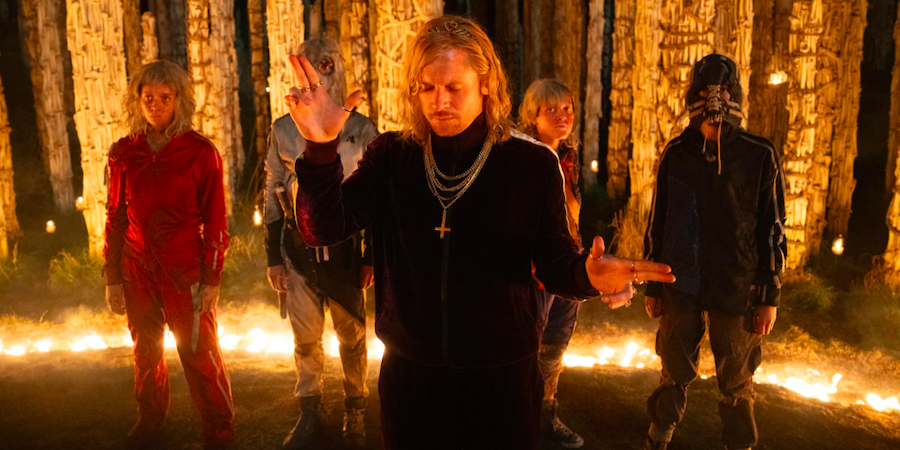
Some important context: The Bone Temple actually has very few zombies, and is largely the story of Jimmy Crystal (Jack O’Connell), the leader of a cult that Spike has fallen in with. Crystal believes he’s the son of Satan, and he forces his followers (a group of young kids/teens all named Jimmy) into Satanism.
When they find the bone temple (created by Dr. Kelson), Crystal tells them that’s where Satan, his father, lives. He makes a deal with Kelson – convince his followers that he is indeed the son of Satan, and he’ll let him live.

Sony Pictures
You’d expect the ensuing moments to culminate in violent carnage. Instead, The Bone Temple offers an unforgettable musical number.
Yes, you read that right.
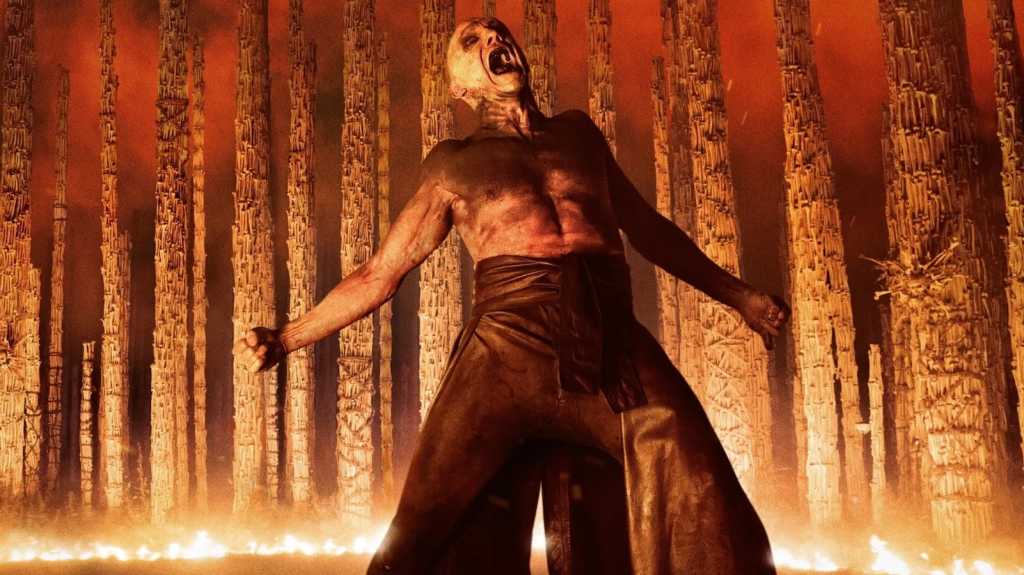
To convince Crystal’s clan that he’s Satan, Kelson sets up a remarkable pyrotechnics display around the bone temple, paints himself black, and turns the speakers up to 11. Then, as the Jimmys watch in complete awe, Kelson performs a lip-sync performance of Iron Maiden’s “The Number of the Beast”.
It delivers the excitement that a bloody brawl could only dream of
Of all the surprises in the entire 28 film series, this is by far the biggest. And that’s saying something, considering The Bone Temple also has a scene where Kelson dances with an alpha zombie to a Duran Duran song. But what’s so wild about watching a mostly-naked Ralph Fiennes perform to Iron Maiden in the film’s emotional climax is that it delivers the excitement that a bloody brawl could only dream of.
The performance has all the tension and significance of a fight for his life. That’s because Kelson’s life does depend on convincing the cult of Jimmys that he is indeed Satan personified. Fiennes has been a tremendous actor his entire career, but this moment in The Bone Temple is a whole other level of brilliance. It’s a spellbinding sequence, as Fiennes commits with every fibre of his being to the demonic, flailing around in the song in a fashion that’s every bit as unpredictable as The Bone Temple itself.
It’s the kind of moment film fans will be referencing years from now. Fiennes’ Kelson accesses all the darkness inside of him, unleashing it in a devilish, explosive moment. It’s enough to make you believe that Bone Temple has another twist up its sleeve, that Kelson might actually be Satan. The scene is the perfect example of what makes The Bone Temple such a bold movie, emblematic of the unexpected nature that’s fuelled this stunning series since 2002.