
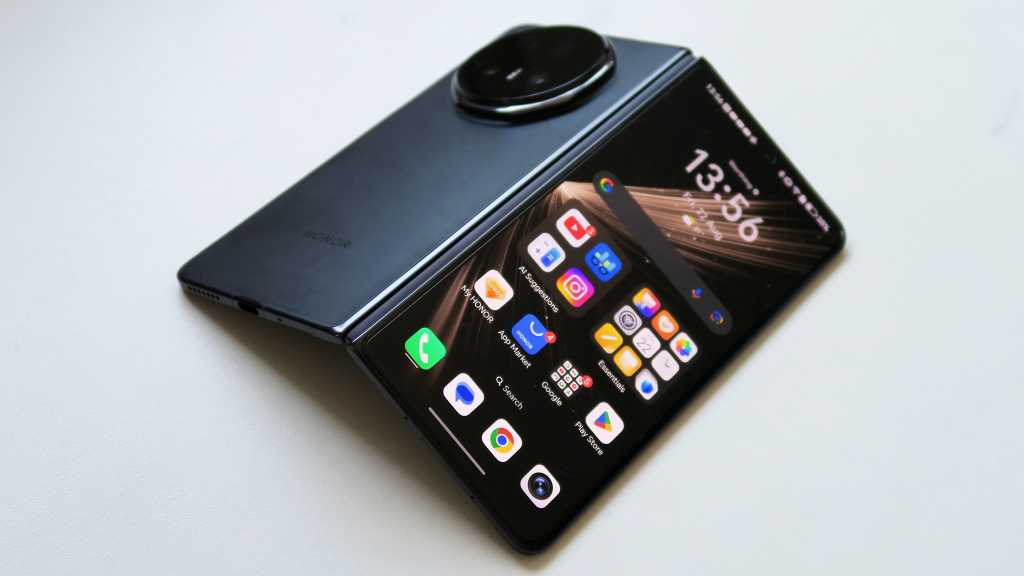


At a glance
Expert’s Rating
Pros
- Excellent performance
- Feature-rich user experience
- One of the best camera systems on a foldable
- Maintains stylus support, unlike rivals
Cons
- MagicOS won’t be to everyone’s tastes
- Smaller main display than rivals
- Audio quality could be better
- Expensive
Our Verdict
Provided you can get on with Honor’s MagicOS user experience and the mountain of features at your disposal, the Magic V5 is one of the most competitive book-style foldables on all fronts, whilst also undercutting its hottest competition on price.
Price When Reviewed
This value will show the geolocated pricing text for product undefined
Best Pricing Today
Best Prices Today: Honor Magic V5


2025 has fast become the fiercest year for foldables yet, with Oppo, Samsung and Google all serving up incredibly strong entries in their respective book-style folding phone lineups. But now it’s Honor’s turn, and the long-anticipated Magic V5 clearly has its sights set on foldable supremacy.
With so much going on in the foldable space this season, Honor has been keen to hold attention; actively promoting the Magic V5 in the months leading up to its launch, touting key features, revealing specs and even granting press and influencers impressively early access to hardware. The phone hit pre-order in China on 2 July, but almost everywhere else, fans have been made to wait until now to get their hands on the latest in the company’s Magic V series.
On the surface, the Magic V5 looks like the most uncompromising foldable of the year, but having lived with the V5 for the last few weeks, can it actually deliver on various lofty promises?
Design & Build
- Claim to world’s thinnest “book-style” foldable at launch
- IP58 & IP59 certified
- From 217 grams
One of the most contentious battles amongst this year’s crop of book-style foldables has been with regards to thickness. The Oppo Find N5 (pictured below, in black) touched down back in February, laying claim to the title of “world’s thinnest book-style foldable” with a profile of 4.21mm when open.
Honor wasn’t going to let that slide, however, with the Magic V5 and its promised record-breaking wafer-thin profile arriving a few months later.

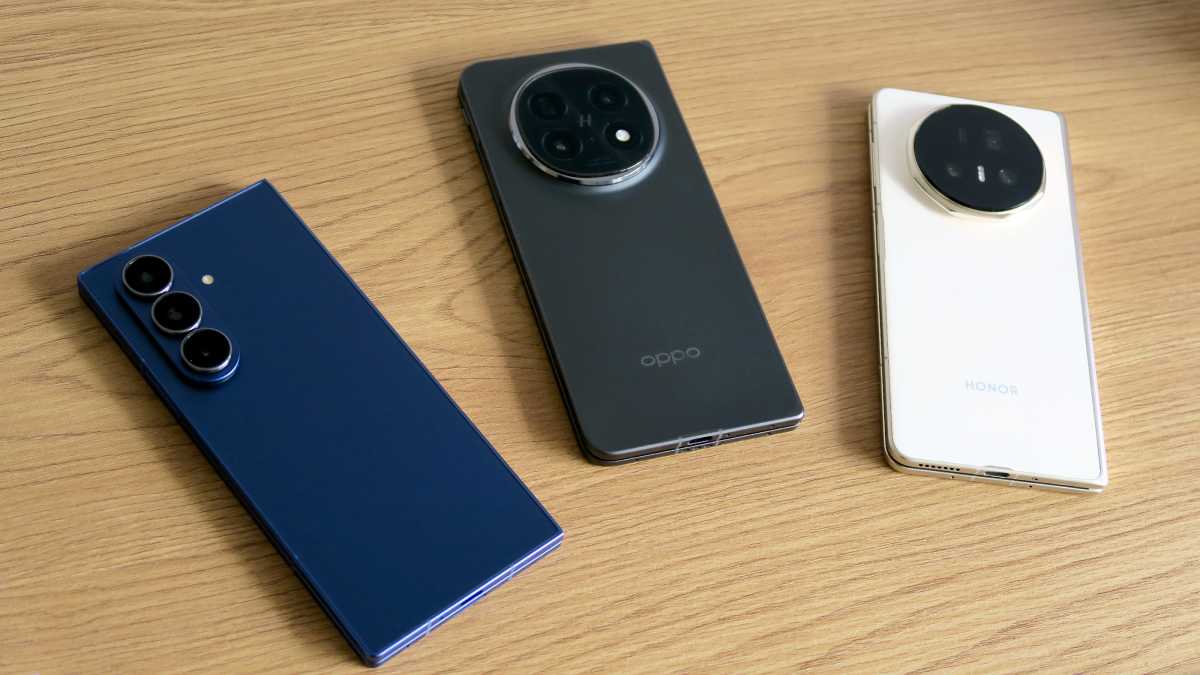
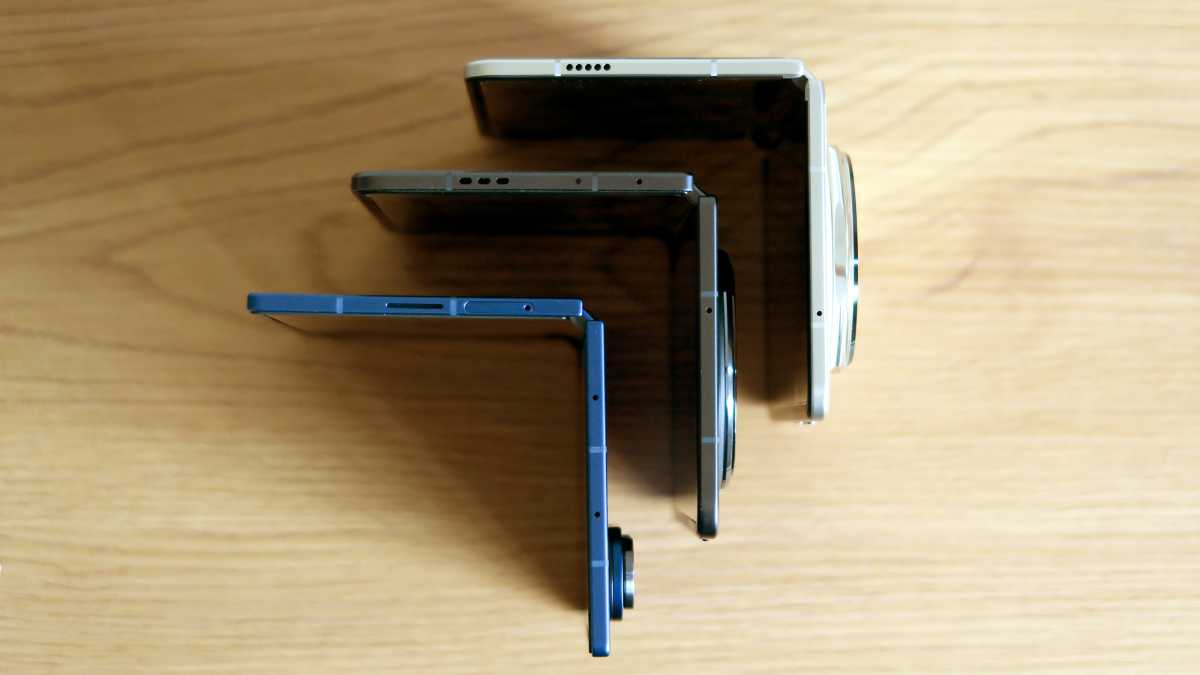
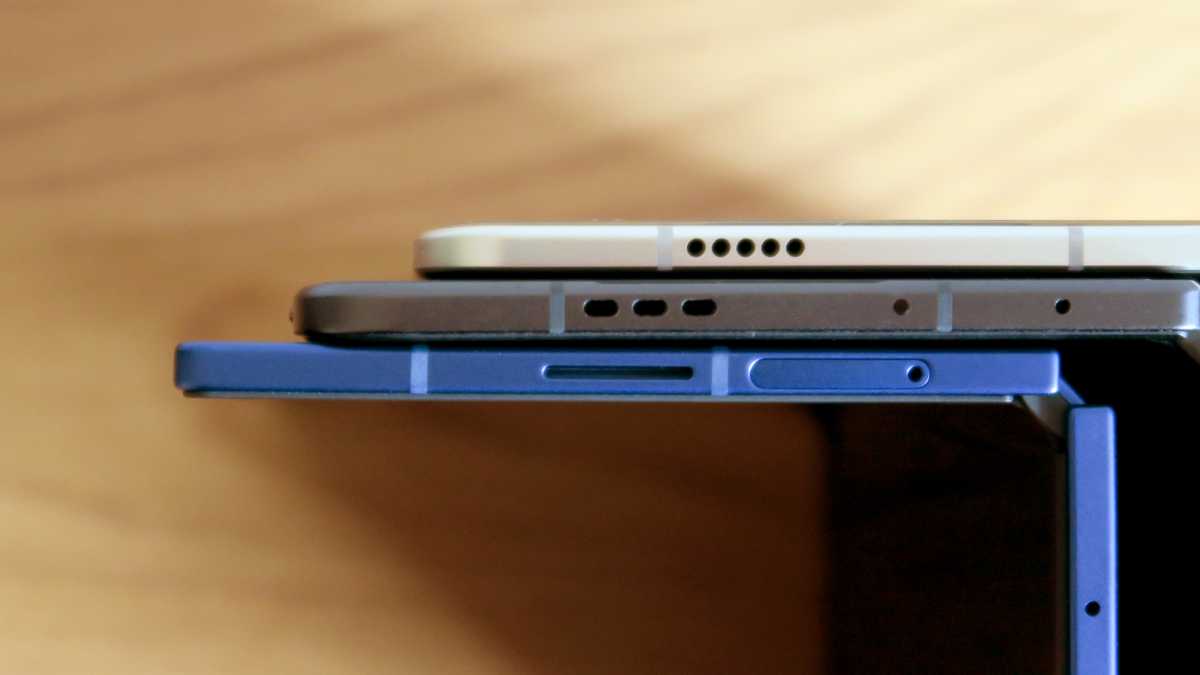
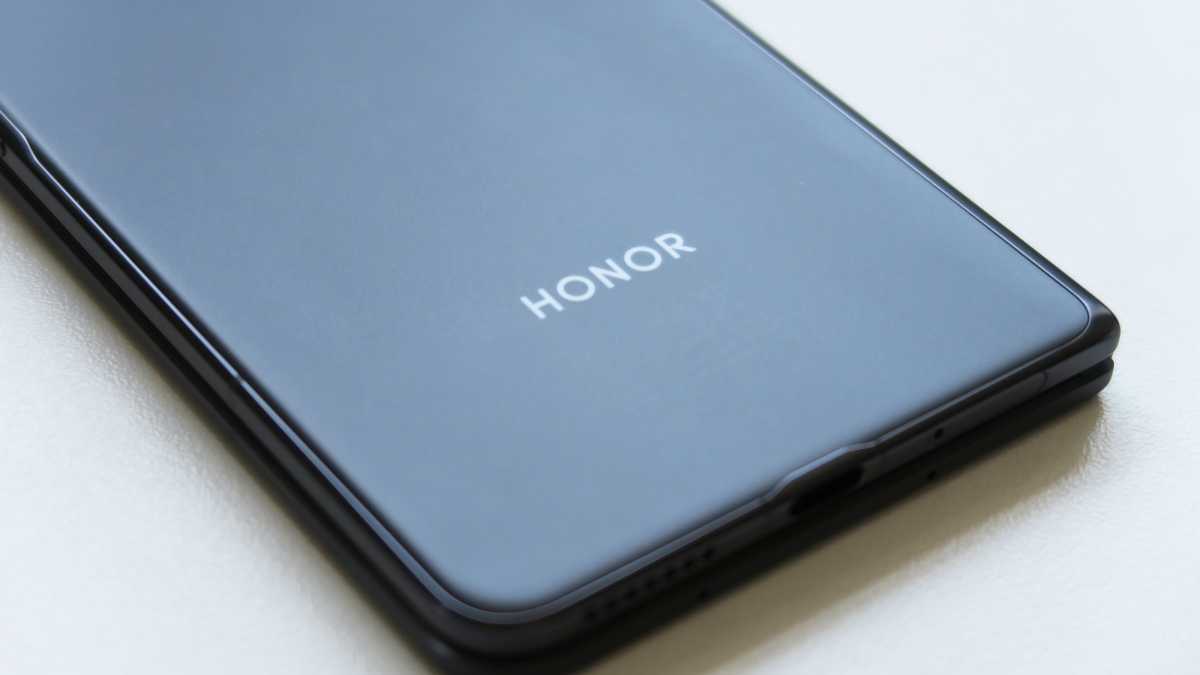
Honor serves up the Magic V5 in four colourways: Dawn Gold, Reddish Brown, Ivory White (as seen above) and black, and having handled them all, Dawn Gold gets my vote as the most audacious, head-turning foldable finish currently on the market (closely followed by the Samsung Galaxy Z Fold 7 in Blue Shadow). That beauty is more than skin deep, too, with the finish also affecting thickness.
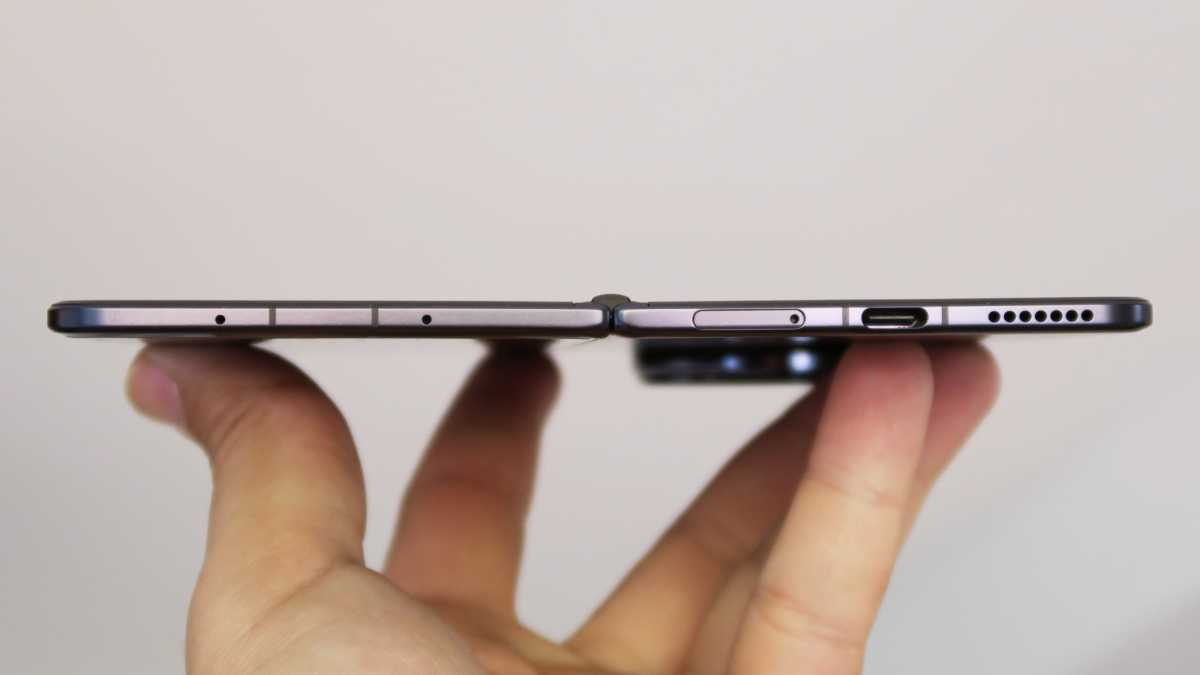
If you’re after the entry Honor’s put forward as the world record-breaker, you’ll want the Ivory White model; cited as measuring 8.88mm when closed and an insanely thin 4.1mm when open. However, the other finishes are still outlandishly svelte too, at 9mm when closed and 4.2mm when open.
You no longer have to compromise on thickness to enjoy a foldable phone
I would ward off anyone planning on picking the Magic V5 explicitly because of its claim to the title of “world’s thinnest”. Honor’s metrics don’t take into account pre-fitted screen protectors and camera bumps, but even factoring these elements in, taking my own set of digital callipers to Honor’s, Samsung’s and Oppo’s latest undermined the V5’s claim to the throne, if only by a hair.
Even so, we’ve reached dimensions with book-style foldables that mean you no longer have to compromise on thickness to enjoy a foldable phone. Even with a case, they’re still thinner and less obtrusive in the pocket than my Mous case-clad Samsung Galaxy S25 Ultra, and at between 217g and 222g, they weigh about as much, too.
Ergonomically, the Magic V5’s rounded edges set it apart from the flat surrounds of its most like-minded rivals, and though perhaps a little trickier to pry open as a result, this distinction makes for a more ergonomic, comfortable fit in the hand.
Foundry | Alex Walker-Todd
In terms of opening and closing the V5, Honor’s also ensured the revised hinge mechanism is rated to withstand up to 500,000 rounds of being opened and closed, which equates to (up to 10) years of use without failure. What’s more, an additional carbon fibre layer beneath the phone’s main folding display helps deal with shock resistance from drops, too.
In practice, despite almost a month of use, aside from picking lint out of the crease after being in my pocket for a long time, the Magic V5 is decidedly free of blemishes, from its screen protector-laden outer display to its composite back.
I also need to commend Honor’s engineers for creating the first foldable I’ve encountered that can actually detect foreign objects within the display area when you try and fold it closed, warning you to give it a clean before folding it away.
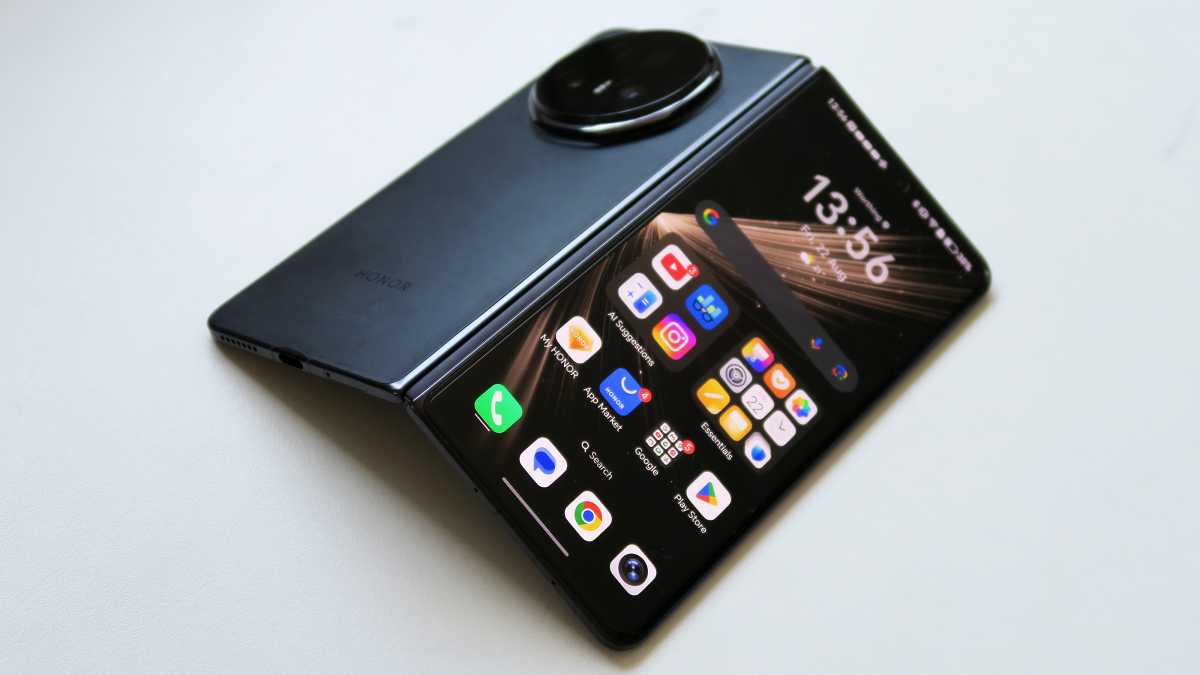
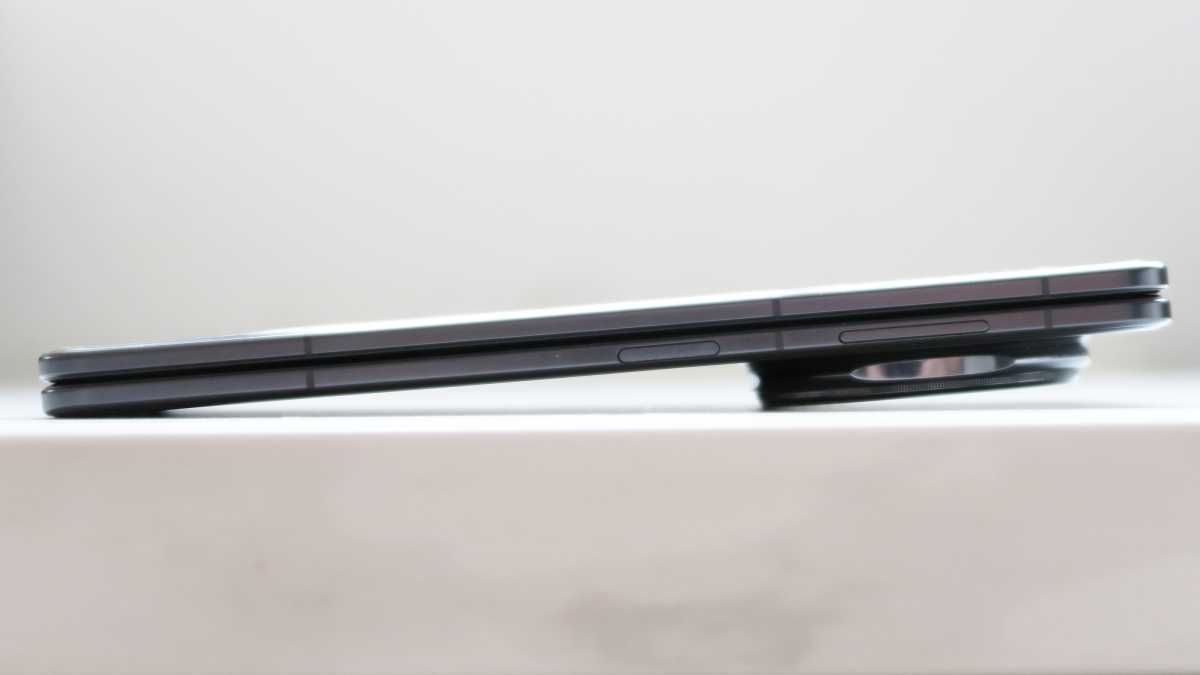
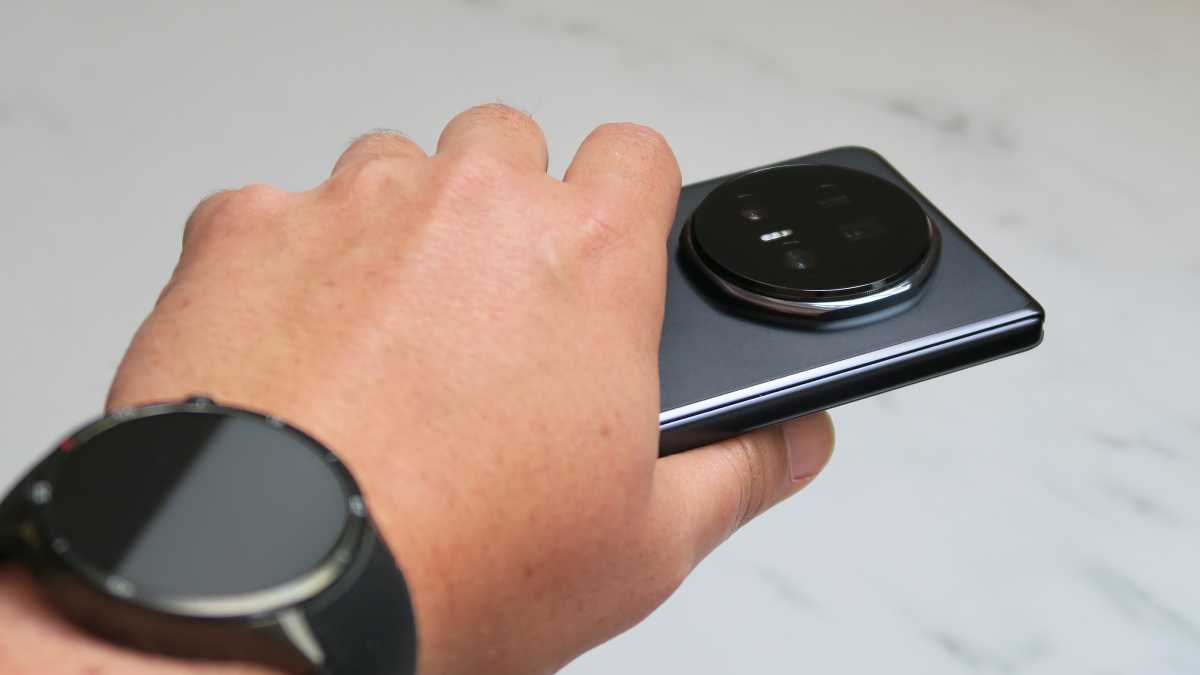
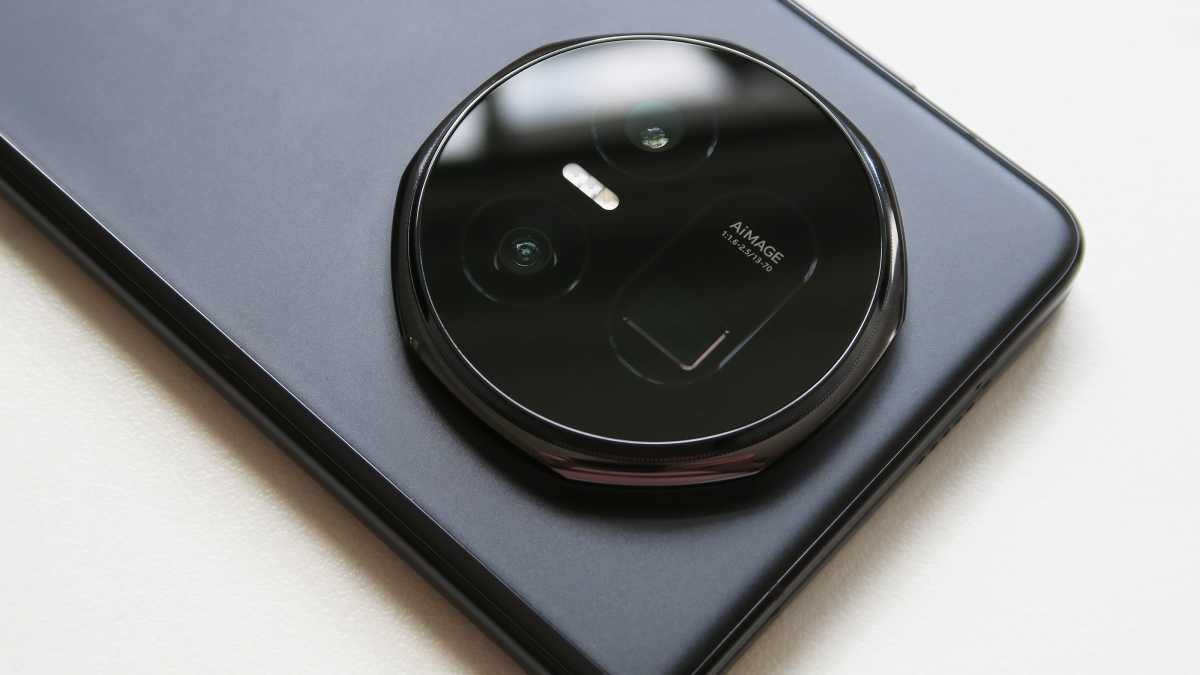
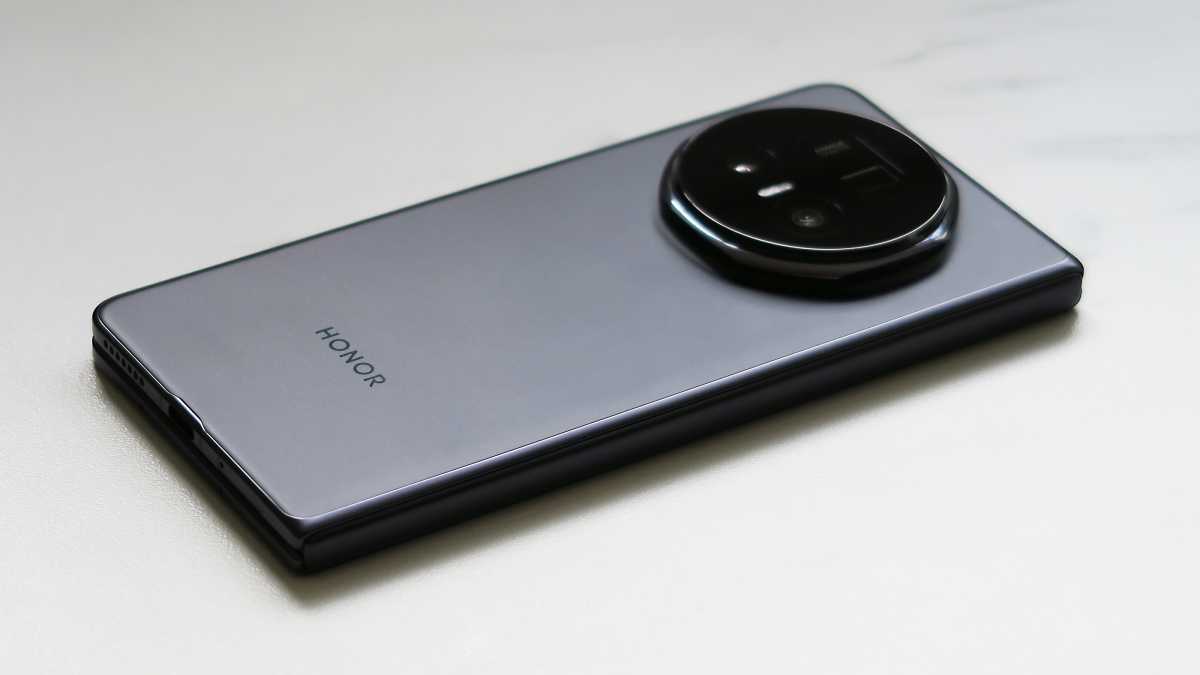
Unlike the Z Fold 7’s offset vertical camera setup, the back of the V5 plays host to a far more prominent circular module, spanning the entirety of the phone’s back (when closed).
On the one hand, it’s huge and tends to catch in my pocket when putting the phone away, but on the other, it makes for a handy ledge for your finger, reducing slippage (akin to a Popsocket), and renders the V5 more stable (compared to the Fold 7) when placed on a flat surface.
Just a week before the Magic V5’s international launch, Google pulled the wraps off the Pixel 10 Pro Fold, and it comes with a world-first of its own; boasting impressive IP68-certified protection against dust and water ingress, out the box.
While this is an undeniable achievement for a foldable, Honor was seemingly prepared for such a challenge, with the V5 sporting only marginally lesser IP58 certification (indicating weaker resistance to dust and dirt than the Pixel), but also IP59 certification.
As such, it’s equipped against more intense water pressure than any other foldable currently on the scene (for reference, the Z Fold 7 is only rated with IP48 protection); getting splashed by a passing car or drenched on a log flume shouldn’t spell instant death for Honor’s latest as a result.
Regardless of the durability promises the Honor Magic V5 makes, at this price point, it’s also worth checking what Honor’s customer service is like in your region. Despite the brand’s international prevalence, Honor’s product support network might not be as robust as, say, Samsung’s. Just something to consider.
Screen & Speakers
- 6.43-inch 1-120Hz LTPO 2376×1060 AMOLED outer display
- 7.95-inch 1-120Hz LTPO AMOLED 2352×2172 main display
- Honor Magic-Pen stylus support
For a phone that touts spec superiority over its competitors in most areas, it’s a little surprising that the Magic V5 has one of the smallest main folding displays in its class. Not by much admittedly (approximately 0.05 inches), but the panel’s smaller size and thicker bezels compared to the likes of the Z Fold 7 give the phone a fractionally more dated appearance when open.
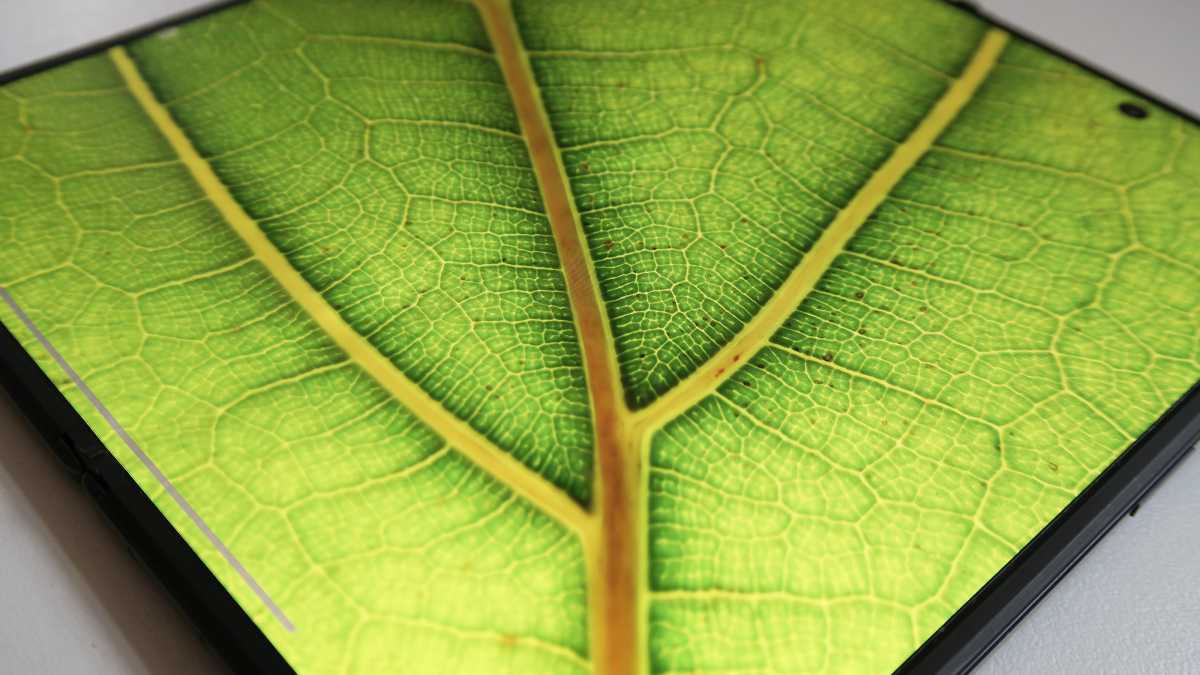
On a technical level, however, Honor has granted the Magic V5 a great pair of 120Hz OLED panels. While I would have appreciated better outdoor visibility whilst testing during the British summer months (the inner display has a panel-wide high brightness mode ceiling of 1300nits, while the external screen reaches 1800nits in HBM), a peak 5000-nit limit (on both displays) is practically unheard of.
It’s about double the aforementioned Find and Fold’s claimed thresholds, and grants the phone outlandishly rich HDR visuals, making it ideal for enjoying movies on the go.
Foundry | Alex Walker-Todd
Honor also dresses its phones’ displays with a wealth of technologies and customisation options, and the V5’s screens are no different. I love the full-colour always-on display, whilst convenient features like double-tap to wake are enabled by default too.
Honor staples such as AI Defocus and 4320Hz PWM (pulse-width modulation) dimming are both present to reduce eye strain and the risk of headaches, plus the phone boasts auto white balance adjustment and even a dedicated monochromatic eBook Mode, (if it isn’t obvious, the V5’s form factor renders it perfect for ereading too).
Along with that carbon fibre layer, Honor has also applied an ‘anti-scratch NanoCrystal shield’ to the phone’s outer display, and ‘Honor Super Armor’ to the main folding panel, which the company claims grants 10x better drop protection, 15x better scratch resistance and 3x better wear resistance than regular glass. And as mentioned before, I’ve had little cause for concern as far as general hardiness and resilience go.
Honor has granted the Magic V5 a great pair of 120Hz OLED panels
As for every foldable’s telltale crease, despite a reduced feel under-finger, it’s about as visible as the one on its predecessor and no better or worse than the competition’s, but in everyday use, I seldom thought about it.
Samsung’s latest book-style foldable sported quite the glow-up when it debuted in July, boasting a significantly thinner profile (on average, around 25% thinner) than its predecessor, but one of the sacrifices Samsung felt as though it had to make to achieve this new silhouette was to ditch long-standing S Pen stylus support. The Magic V5 makes no such compromise.
Despite hovering around the title of “world’s thinnest,” the Magic V5 retains the Honor Magic V3‘s Magic-Pencil stylus compatibility, so if that’s an essential part of the foldable experience for you, it’s Honor, not Samsung, that you’ll want to turn to this year.
Foundry | Alex Walker-Todd
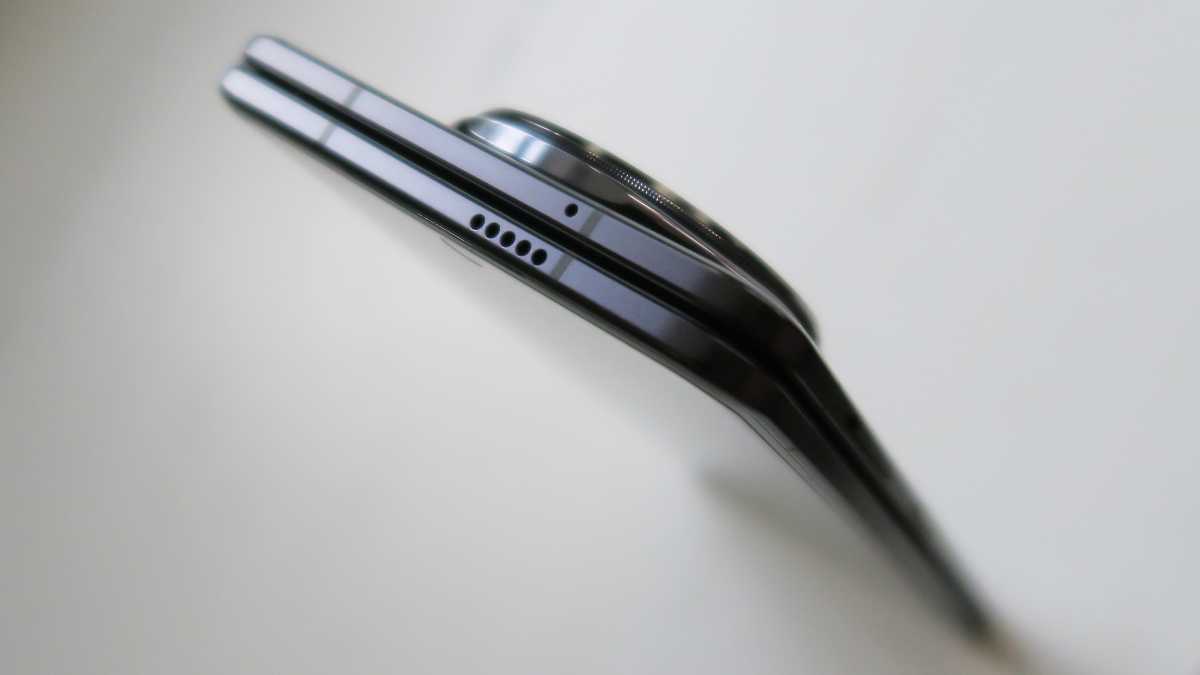
As for audio performance, despite the form factor’s thin nature not exactly lending itself to acoustic prowess, Honor’s done a decent job with the sound output in the Magic V5. You’ll find stereo speaker grilles positioned diagonally when the phone is open, which offer decent clarity at all but the highest volume levels.
Unsurprisingly, the V5 is unlikely to be anyone’s go-to speaker for music playback, with a generally flat sound that could do with more bass (if that’s physically possible with a design like the V5’s?). Stereo separation is surprisingly muddied, too, but it’s still perfectly serviceable audio in the flagship space.
Specs & Performance
- Qualcomm Snapdragon 8 Elite chipset (8-core variant)
- 16GB RAM & 512GB storage
- Storage-based RAM expansion by an additional 16GB
Oppo’s Find N5 was the first book-style foldable to embrace Qualcomm’s latest and greatest Snapdragon 8 Elite chipset, which powers the majority of 2025’s best phones. However, it wasn’t the same version we’d seen on devices up until this point.
Thought to be in the pursuit of better thermal management, the N5 sported a 7-core binned variant of the Elite, meaning weaker CPU performance, which, although only slight, is harder to justify across these phones’ ultra-high price range.
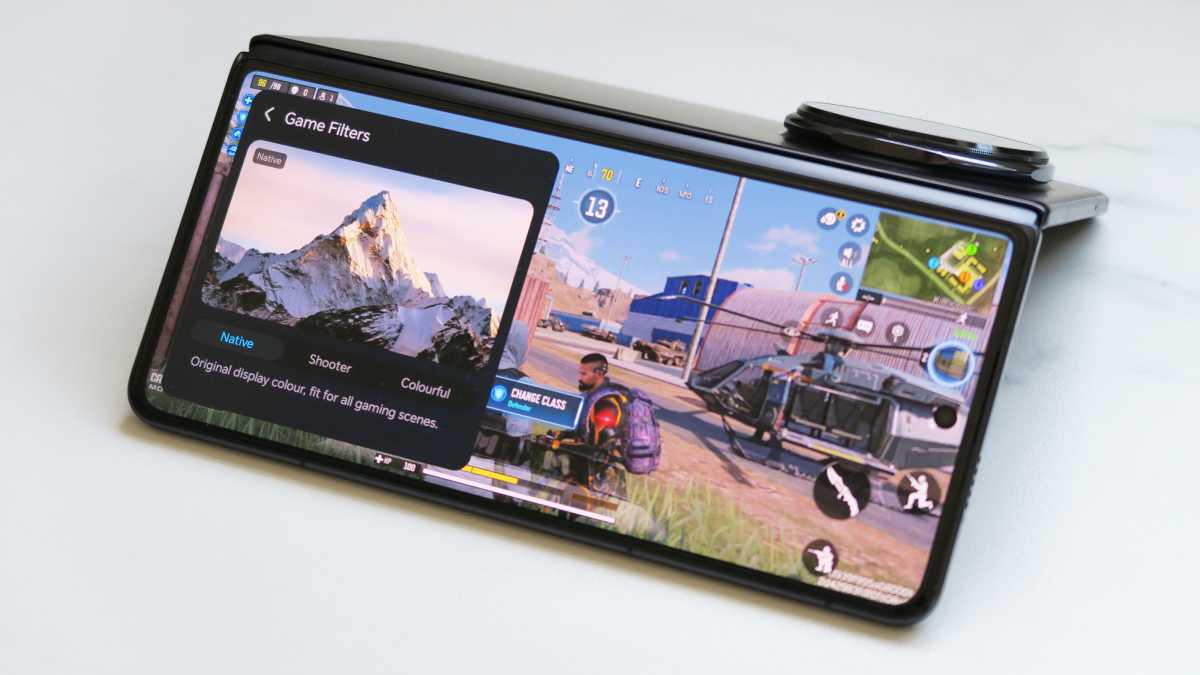
Once again, Honor refused to compromise with the Magic V5, meaning you get that full-fat 8-core version of the Elite (just like you’d find in the Honor Magic 7 Pro), backed by 16GB of (LPDDR5X) RAM, which can be doubled by reassigning an additional 16GB of the phone’s 512GB of (UFS 4.0) storage, using the RAM Turbo feature.
In China, the Magic V5 can be had in 256GB and 1TB flavours too, but overseas, the company has kept things simple, with a single storage option.
Like a lot of Chinese phone makers, Honor ships its phones with a ‘default’ power profile and a ‘performance’ power profile. In the case of the Magic 7 Pro, for example, a difference in benchmark results between the two modes was present, but not major.
While the Magic V5 does indeed run on that 8-core Elite chip, going by its test scores, it looks like the phone prunes performance back compared to similarly-specced candy bar flagships, when using its default power profile, but fully opens the taps in ‘performance’ mode.
Honor Magic V5 benchmarks
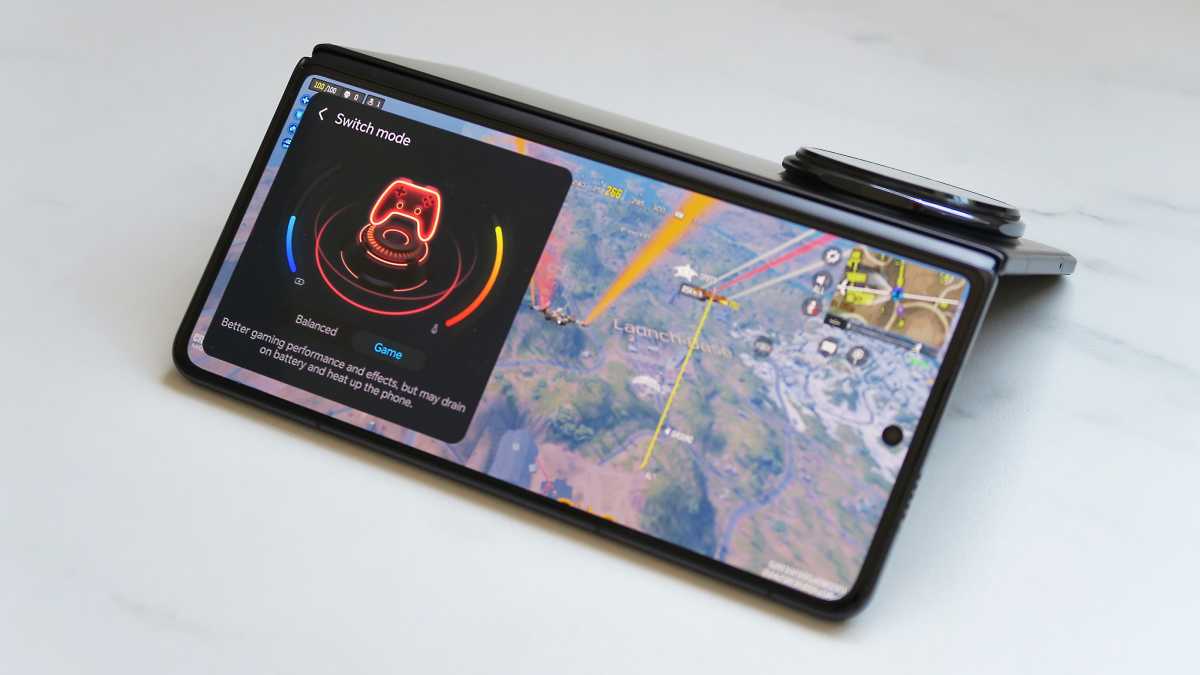
Despite CPU scores closer to a Snapdragon 8 Gen 3-powered phone in day-to-day use, you can switch to performance mode for the full might of the 8 Elite, explicitly when gaming (by way of the phone’s Game Manager feature) or all the time, by dipping into the Battery section of the Settings menu. As you might expect, keeping performance mode always on does burn through battery life faster.
In truth, I have no issue with this approach. The Magic V5 felt perfectly fast and fluid, comfortable with multi-window multitasking and serving up fast app load times, in the ‘default’ power profile; but it’s nice to know that my hands aren’t tied, should I feel the need for some extra grunt.
As for gaming, with performance mode set to auto-enable when I fired up Call of Duty: Mobile, I never noticed dropped frames at default graphical settings, even if the phone did get warm (but never hot) after about 15 minutes of constant gameplay.
Cameras
- 50Mp main, 50Mp ultrawide and 64Mp 3x telephoto sensors
- 20Mp selfie camera (on inner and outer screens)
- Up to 100x AI Super Zoom
The Honor Magic V5 makes a statement with its sizeable rear camera bump, which packs a trio of sensors, similarly to its predecessor. Despite seemingly using the same 50Mp main sensor as the Magic V3, the V5 gains a new, higher resolution ultrawide and telephoto sensors, once again paired with the ability to capture shots at up to 100x, meaning impressive versatility.
One of the big sticking points with the Magic V3‘s camera system was its lacklustre ultrawide, but the jump to new hardware, paired with whatever algorithms Honor has improved up results in far better performance this time around. There’s still an apparent jump in quality, colour accuracy and dynamic range between the ultrawide and main, but it’s far less pronounced than before, meaning greater image quality consistency across the V5’s rear cameras.
Foundry | Alex Walker-Todd
In side-by-side tests with the Z Fold 7’s rear trio of cameras, aside from shooting warmer and, surprisingly processing shots even more so than Samsung, Honor’s foldable camera system generally retains greater detail and does a better job of keeping bloom from light sources in check too.
Low light capture would be the area where I’d suggest Honor focuses on next, as while the Magic V5 proved competent enough, it’s the area where the biggest strides could be made.
One issue is Honor’s exposure times. Even with Night Mode enabled, the Magic V5 was one of the fastest to capture in low-light settings. On the one hand, if there is enough ambient light, you’re likely to get a sharper picture, but otherwise shots simply appear too dark and lack meaningful levels of detail compared to rivals that take more time.







One huge advantage that the foldable form factor does provide is the ability to more readily shoot selfies using the phone’s main sensor, and the gap in quality compared with selfies shot on the V5’s 20Mp in-display sensors is massive.
You can toggle the bokeh (background blur) when using the selfie cameras, or scale it when shooting selfies with the phone’s bigger sensors, but everything from blur quality to edge detection is so much better with the latter. In essence, take Zoom meetings and WhatsApp calls with those in-display snappers, but any other time you want your face in shot, flip to those back snappers.































The V5 also boasts two camera features you’ll most readily find on Google’s Pixels. Honor’s cribbed the Pixel 9 Pro Fold‘s ‘Made You Look’ abilty, which puts cute animated characters on the outer display when the phone is open, allowing you to better hold a child’s attention when snapping a pic, and that impressive-sounding 100x AI Super Zoom.
Even coming from the samples featured in the Honor Magic 7 Pro camera review nearer the start of the year, Honor appears to be constantly improving the imaging models the generative AI Super Zoom is applying to shots. Even so, having just experienced Google’s new 100x Pro Res Zoom on the Google Pixel 10 Pro for the first time, Honor needs to work harder on exposure and fine detail accuracy in its partially-generated high focal range zoom shots.
Battery Life & Charging
- 5820mAh (Si-C) battery
- 66W wired + 50W wireless charging
- 100% charge in 43 minutes (according to Honor)
Cutting-edge battery tech has been a key part of Honor’s flagship phone experience for a while now, and that’s just as true with the Magic V5. In China, if you opt for the full-fat 1TB model, you also get the largest capacity battery on any foldable to yet, at a whopping 6100mAh; trumping the Vivo X Fold 5’s 6000mAh cell.
Internationally, however, the V5 comes with a fractionally more modest 5820mAh power pack instead.
While the 6100mAh variant uses Honor’s latest silicon-carbon tech, the smaller cell relies on previous-generation parts. Don’t be disparaged, though. Looking at the wider foldable market, wherever the Magic V5 is in the world, it’s still equipped with one of the largest and fastest-charging battery setups around, made all the more impressive by that wafer-thin frame.
Foundry | Alex Walker-Todd
In testing, considering its battery capacity, the phone scored lower than I expected when using PCMark’s Work 3.0 Battery test (nine hours and one minute), but in real-world conditions (switching between the phone’s two screens) it delivered a respectable 8.25 hours of screen-on time on a single charge (for reference, the Oppo Find N5 scored 13:58, but in real-world use only managed 5.5 hours of screen-on time).
This equates to around a day and half of use, but even if you were to exclusively use the V5’s main near-8-inch display, it would still likely see you through to the end of a full day, without issue. Compare that to the Z Fold 7’s significantly smaller 4400mAh battery, which on occasion came close to dying after a day’s normal use; not to mention its slower 25W wired and 15W wireless charging.
Honor quotes an impressively fast 43 minutes for a full charge, when leveraging the Magic V5’s maximum 66W wired charging speed, and 50% charge in just 16 minutes. I didn’t hit these lofty figures, but I came close.
In testing, my Magic V5 hit 34% in 15 minutes and fully replenished after 53, but after multiple runs, I think I figured out why I wasn’t reaching Honor’s record.
Safely managing recharge speed and heat build-up is critical
With the more challenging thermal envelope a phone like the Magic V5 possesses, safely managing recharge speed and heat build-up is critical. To mitigate this, the Magic V5 is the first foldable I’ve encountered that actually asks (with an on-screen pop-up) to be charged whilst unfolded, as doing so expands its surface area, for greater heat dissipation, like a heatsink.
While I never performed a full charge test with the V5 open like this the entire time, quick refills proved more effective compared to when I typically charged the phone closed for the same period of time.
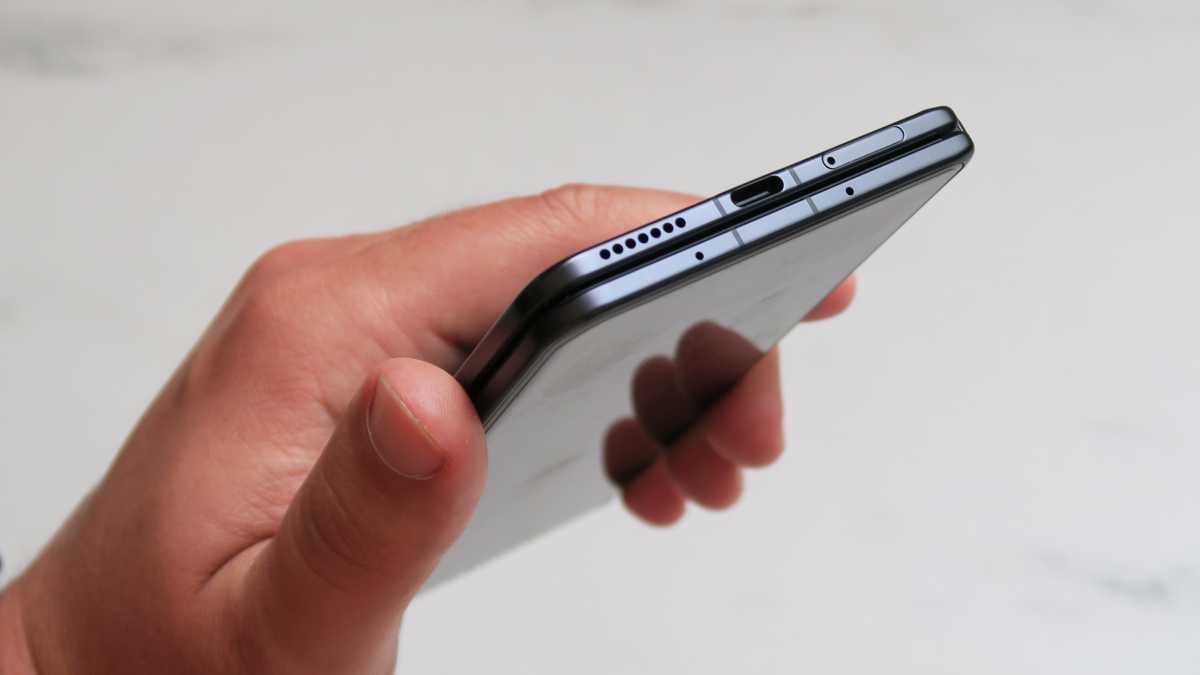
50W wireless charging is a nice inclusion too (again, all the more impressive, considering the V5’s thickness), although, depending on which market you’re in, you’ll have to buy an official power adapter and/or wireless charger separately.
Check out our rundown of the best battery life phones for more.
Software & Apps
- MagicOS 9.0.1 atop Android 15 (at launch)
- New multitasking UI in Multi-Flex mode
- 7 years OS + security update support
While Android 16 is now here – thanks to the arrival of the Pixel 10 series, just last week (at the time of writing) – Honor hasn’t yet had a chance to update the V5 to run on this fresh release. That said, when asked, the company confirmed that it’s working closely with Google on its updates.
With more modest devices – like the Honor 400 Pro – confirmed to be running Android 16 before the year’s end, it seems safe to assume that the V5 will receive a similar uplift by then, if not sooner. Honor also upped it software commitment back in March, meaning the V5 also benefits from the promise of 7 years of OS and security updates, which is amongst the best in the industry.
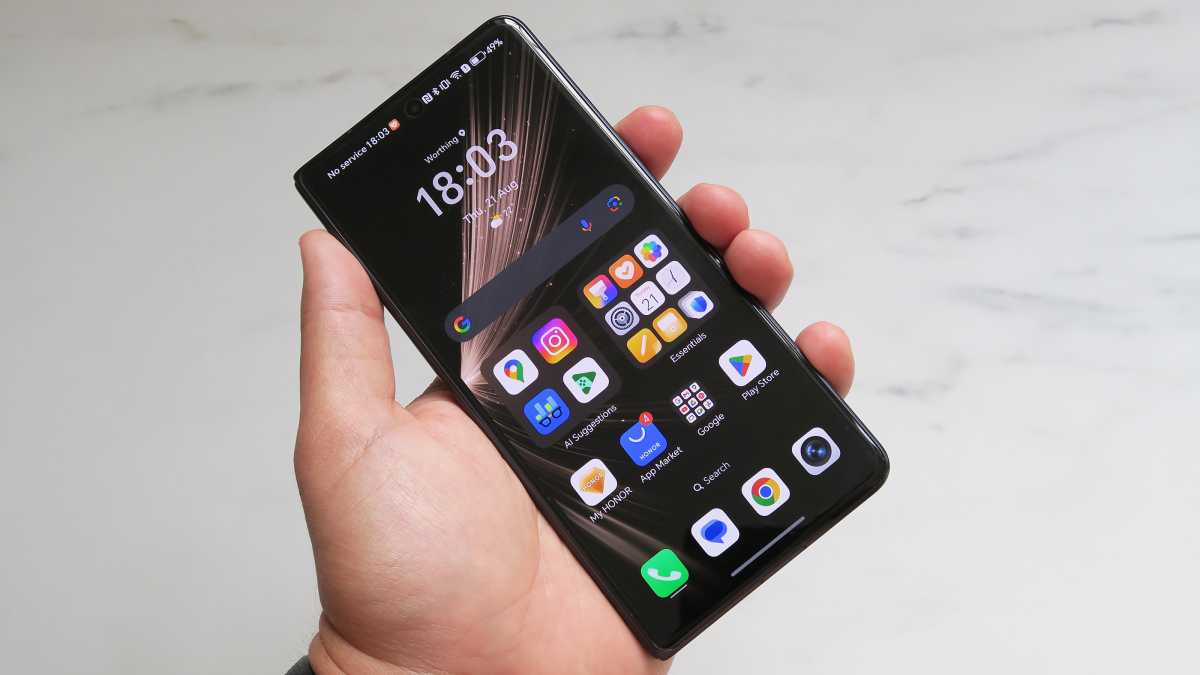
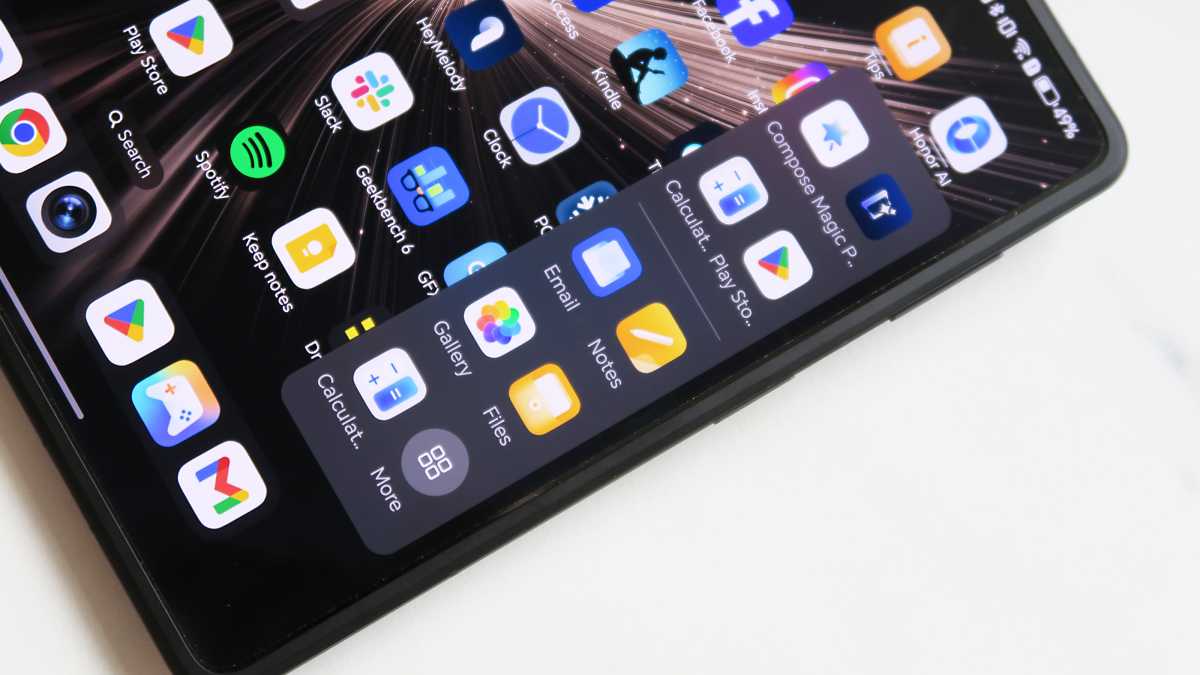
Out of the box, the Magic V5 sports the company’s latest MagicOS 9 user experience (version 9.0.1 at the time of writing), which comes with an increasingly familiar gamut of features, many of which are underpinned by – say it with me now – AI.
While I can’t say I love the look and feel of MagicOS as much as clean Pixel-flavoured Android, it does offer heaps of native customisation, and it’s dressed with an ever-increasing assortment of useful (and, admittedly, not so useful) everyday features.
The new Motion Sickness Relief tool adds dots around the edge of the screen that hold their position whilst your phone bounces around in your hands whilst on a train or in a car. These stabilised reference points apparently trick the brain, reducing the sense of motion and alleviating nausea, for those who remain dead-set on keeping eyes on their display whilst moving.
The experience of jumping between apps on the V5 feels totally seamless
Honor states that its tech is 85% effective against 360° motion sickness. It’s a great addition that I first encountered within iOS, but nonetheless appreciate Honor’s cribbed version here.
Magic Capsule is another iOS-like implementation of a persistent, dynamic notification, only appearing whilst you’re playing media, recording audio or have a timer running; granting quick access to the relevant controls, without having to swipe down into your notifications or go hunting for the related app itself.
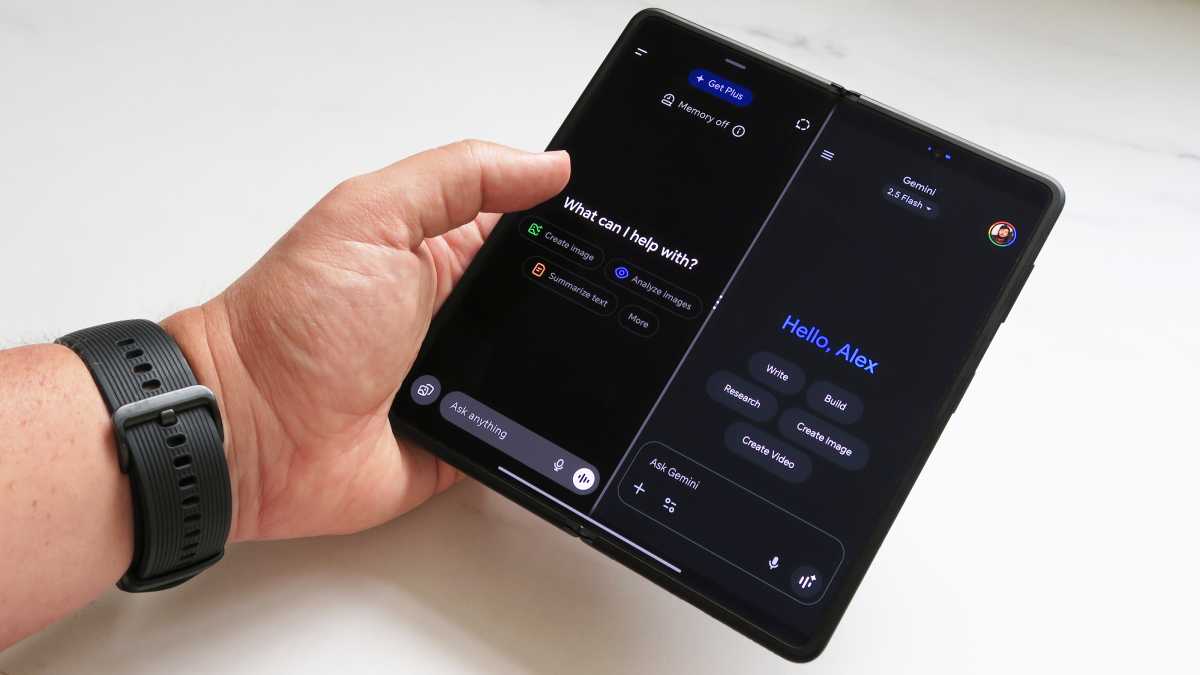
One addition new the the V5 that Honor appears to have “borrowed” from Oppo/OnePlus this time, is what it calls Multi-Flex.

Foundry | Alex Walker-Todd
While you’ve been able to split-screen multitask on Honor phones for a while – running a third app within a floating window on more advanced models – just like Oppo’s/OnePlus’ Open Canvas, Multi-Flex allows for three full-screen apps to run side-by-side-by-side, shunting whichever app you’re using the least mostly off the edge of the screen.
Then, by tapping on the edge of the lesser-used app still peeking out, the UI will shift that app and the one next to it back onto the screen and move the app on the other end off to the other side. Multi-Flex, paired with Honor’s already varied and versatile multitasking experience, means the experience of jumping between apps on the V5 feels totally seamless.
A feature that’s becoming increasingly prevalent is various Android phone makers’ proprietary solutions for sharing to and from Android. For some reason, only Chinese companies seem to be jumping on this functionality so far, with the likes of Samsung, Sony, and other big names seemingly ignoring its potential.
As an Android phone user who defaults to an iPad for tablet usage, the Magic V5’s ability to wirelessly share files to and from iOS / iPadOS via Honor Connect is a hugely appreciated addition. In some markets, Honor also offers a macOS client for similar AirDrop-like convenience, but I apparently don’t live in a region where this client is supported… yet.
Foundry | Alex Walker-Todd
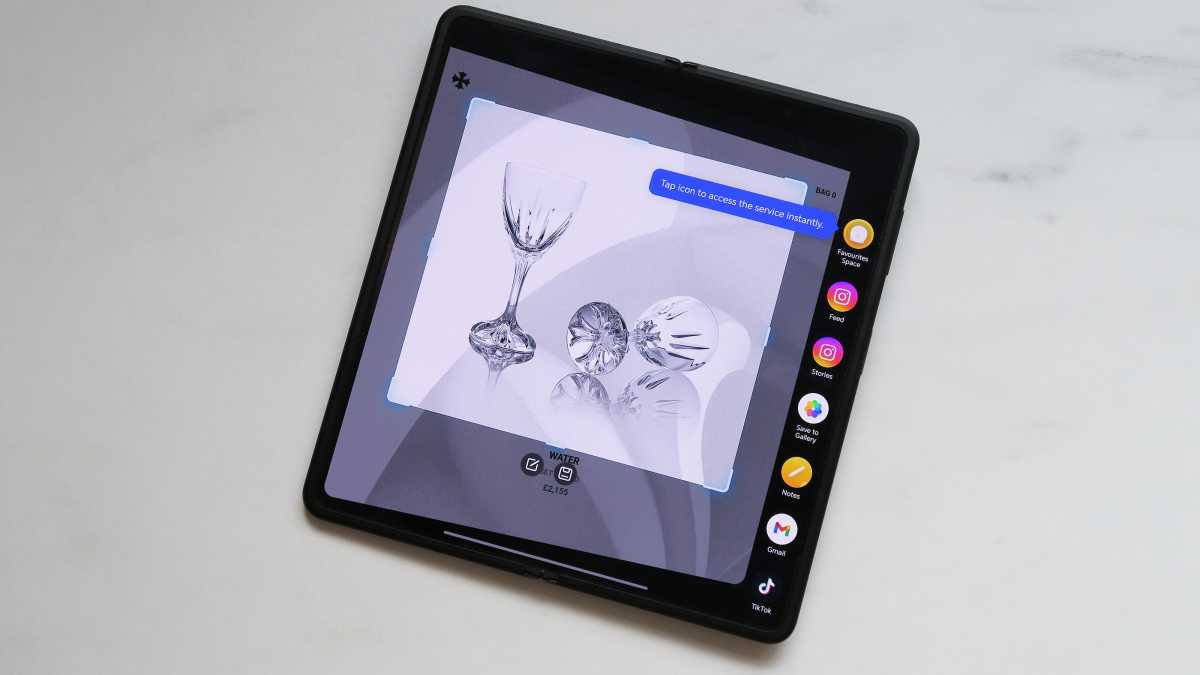
Honor has also poured time and energy into exclusive features like AI DeepFake detection – which is included on the V5 – as well as its own take on Google’s Circle to Search, called Magic Portal. Encircled text and on-screen media can instantly be shared to other Honor-specific apps and experiences, like Favourite Space, on top of being thrown into a Google Search or shared to the phone’s Gallery.
The company’s Magic Sidebar is also great at dynamically surfacing AI features like summarisation when browsing a web page or composition when writing a note, and it makes for a pretty friction-free reason to use such features, which I thought would otherwise go untouched.
Price & Availability
Despite launching in China already (and subsequently other APAC markets like Malaysia), Honor Magic V5’s full international roll-out hit on 28 August, with the single 512GB storage SKU coming in at £1699.99, just like the Magic V3 before it and the V2 before that (European pricing clocks in at €1999).
You can buy the Magic V5 directly from Honor in the UK.
It’s most fierce competitor – the Samsung Galaxy Z Fold 7 – starts at £100 more in the same market, but for that price you’re getting half as much storage and only 12GB of RAM (plus a gamut of other compromises that I’ll come to), the caveat being that Samsung is able to sell its next-gen foldable in the US, whilst Honor is not.
See more options in our guide to the best foldable phones you can buy.
Should you buy the Honor Magic V5?
Everything that was true of the Magic V3 is just as true of its successor. Honor has again proven its mastery of mobile engineering, and created one of the most technically capable devices out there; from hardware design to performance, battery tech to photographic ability. But just as what made the V3 so good has only been enhanced with the Magic V5, so too are the areas where Honor’s phones tend to falter.
Foundry | Alex Walker-Todd
Provided you’re comfortable getting to grips with some of the clunkier aspects of the phone’s MagicOS experience, and you don’t take umbrage with the assortment of features unashamedly lifted from other phone makers’ software experiences, the feature density and versatility served up by the Magic V5 is unprecedented.
After reviewing the Z Fold 7, we dubbed it ‘the best foldable phone’. But if, for whatever reason, you don’t like any aspect of Samsung’s take on a book-style foldable in 2025, you’ll be better served by the Honor Magic V5.
Specs
- MagicOS 9.0.1 atop Android 15 (at launch)
- 6.43-inch 20.7:9 1-120Hz 2616 x 1140 LTPO AMOLED outer display protected by Nanocrystal Glass
- 7.95-inch 9.9:9 1-120Hz 2480 x 2248 LTPO AMOLED main display
- Side-mounted capacitive fingerprint sensor
- Qualcomm Snapdragon 8 Elite chipset (8-core variant)
- 16GB RAM (LPDDR5X)
- China: 256GB, 512GB, 1TB | RoW: 512GB (UFS 4.0)
- Cameras:
- 50Mp ƒ/1.6 main sensor w/ OIS
- 50Mp ƒ/2.0 ultrawide
- 64Mp ƒ/2.5 3x telephoto w/ OIS
- 20Mp ƒ/2.2 selfie camera (both inner and main displays)
- Stereo speakers
- Dual-SIM
- Wi-Fi 5/6/7
- Bluetooth 6.0
- China: 6100mAh | RoW: 5820mAh battery
- 66W wired charging
- 50W wireless charging
- 156.8 x 74.3 x 8.8mm | 9.0mm (closed) | 156.8 x 145.9 x 4.1mm | 4.2mm (open)
- IP58 & IP59 certified
- 217g (Ivory White only), 222g (all other colourways)
- Colours: Dawn Gold, Reddish Brown, Ivory White, black