
I still remember when I saw the first mainstream folding phone.
The original Samsung Galaxy Z Fold was presented to the media in a back room during the IFA trade show in Berlin, and it was one of the times in my 15 years as a tech journalist where I remember being blown away. Not because it was perfect – it wasn’t, of course – but because it was a defining moment in the last two decades of phones.
Fast forward seven years, and here we are again. The Samsung Galaxy Z TriFold is another one of those moments. It’s not the first tri-folding phone to launch – that accolade belongs to Huawei and it’s Mate XT Ultimate Design, but it’s the first to adopt this specific folding mechanism. It’s also added a little sparkle back into the folding phone market again.
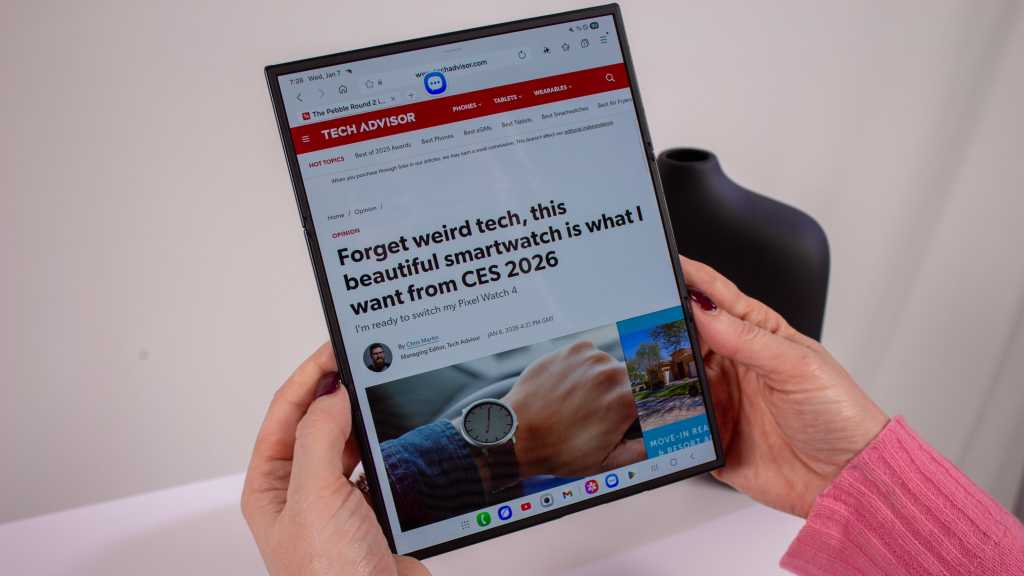
Moving beyond the now-standard book-style and flip-style folding phones, the Galaxy Z TriFold is Samsung’s vision of the future. Despite the name, it folds only twice, but this is enough for it to go from a standard smartphone size to a 10-inch tablet.
I spent some time using it at CES 2026, and these are my first impressions.
An incredible design, but it’s not perfect
The Samsung Galaxy Z TriFold is much lighter than I expected. Don’t get me wrong, it’s not light like the Apple iPhone Air or the Samsung Galaxy S25 Edge, but for what you’re getting here, picking it up for the first time had me pleasantly surprised.
At 309g, it’s heavier than the likes of the Samsung Galaxy S25 Ultra or the Apple iPhone 17 Pro Max, but compared to most tablets (which regularly exceed 450g), it’s incredibly lightweight. Crucially, it achieves this without feeling flimsy at all.

Britta O’Boyle
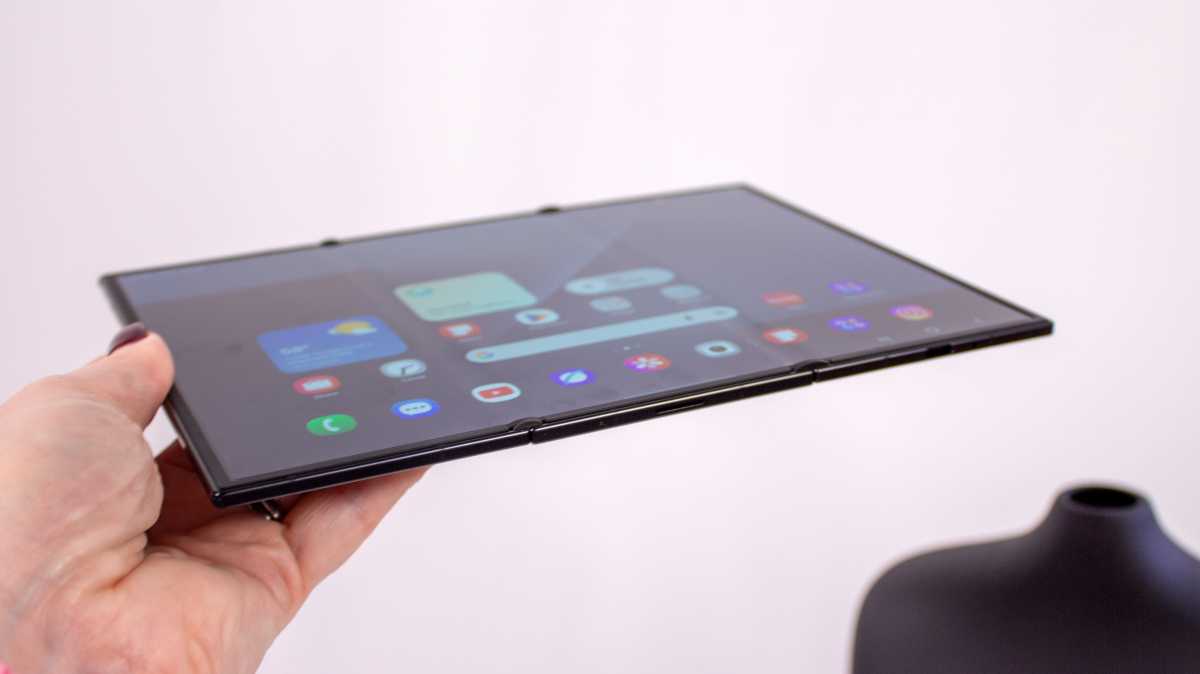
It’s also incredibly slim when unfolded, measuring just 3.9mm at its thinnest point. To give that some context, the iPhone Air is 5.6mm while the iPad Pro is 5.4mm, and both are considered to be impressively slim devices. The Galaxy Z TriFold is taking things to a new level. The combination of the slim frame and lightweight chassis makes for a device that’s very easy to manage, too.
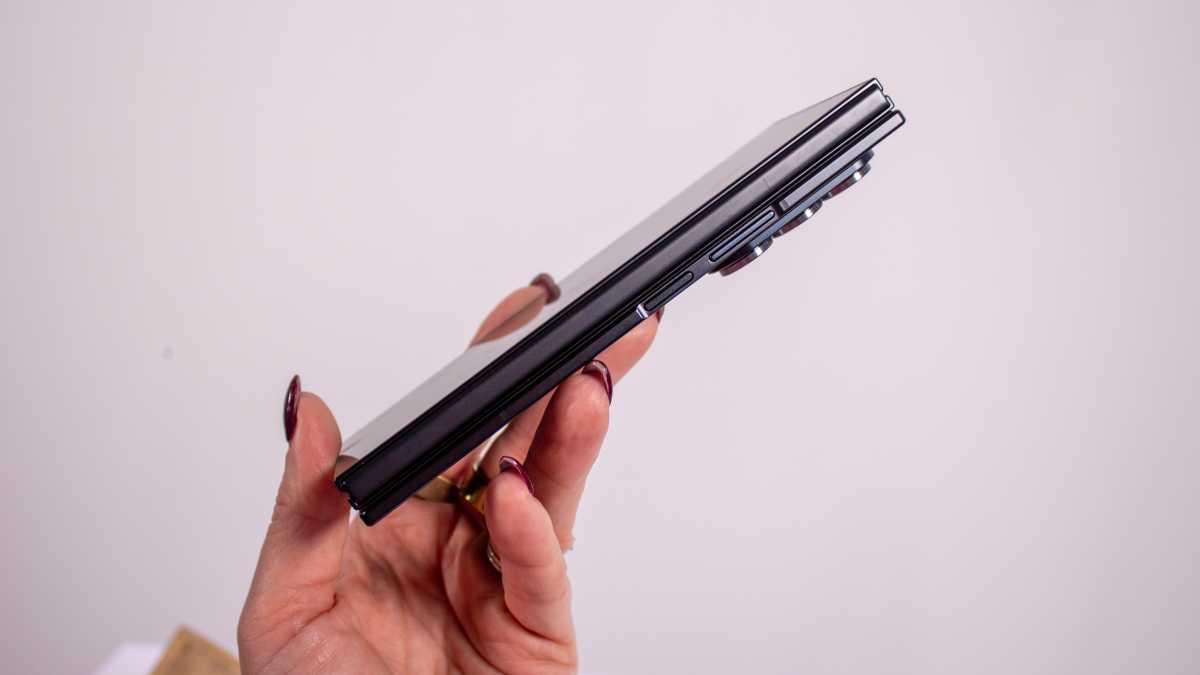
When folded, I don’t think it felt all that different to the Samsung Galaxy Z Fold 7 in terms of thickness, despite having an extra section of phone folded in. Unfolded and it needs two hands for the most part, but unlike a tablet, it is light enough to hold with one hand for reading or watching without feeling uncomfortable.
Britta O’Boyle
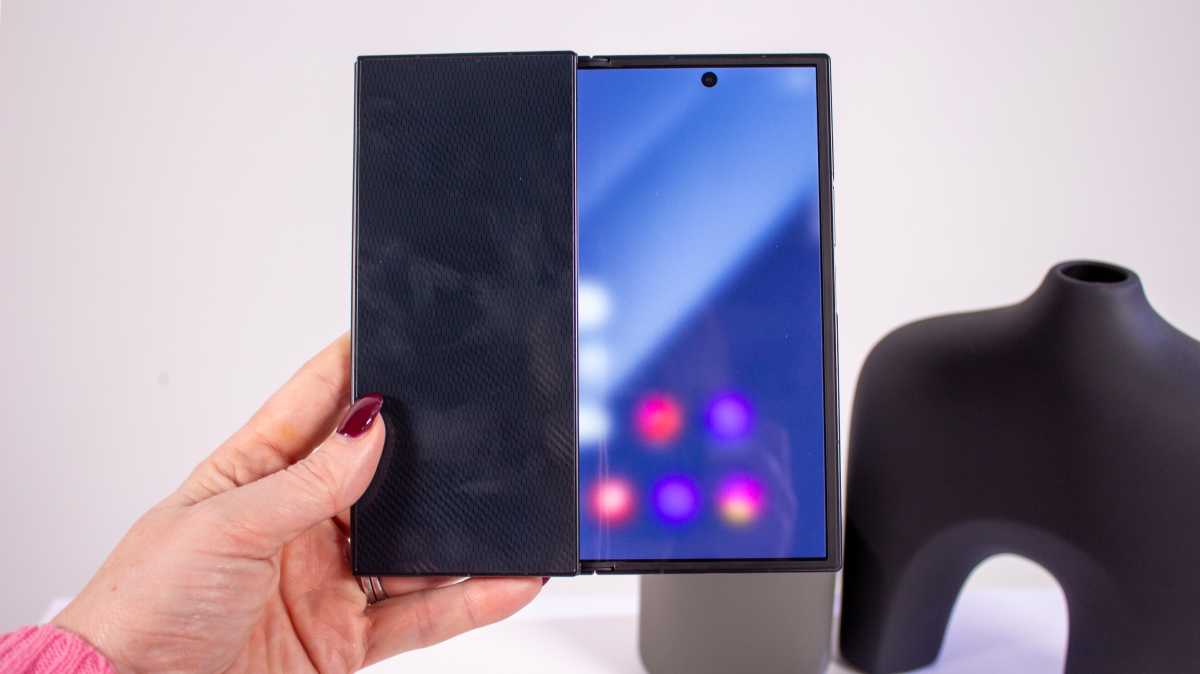
The left panel folds in first, before the right panel folds over the top, which feels like the wrong way round when you consider how you would open a book. That’s my first niggle. It also means you can’t take advantage of either of the folds for a different viewing angle.
On both the Galaxy Z Fold 7 and the Galaxy Z Flip 7, you can set them on a table unaided to watch something on the top half of the screen, and the software on the bottom half of their screens will adapt accordingly. That’s not possible here – it’s either folded or unfolded, with no mid-fold point feeling secure enough to leave in position without being propped up.
The combination of the slim frame and lightweight chassis makes for a device that’s very easy to manage
Very impressive displays
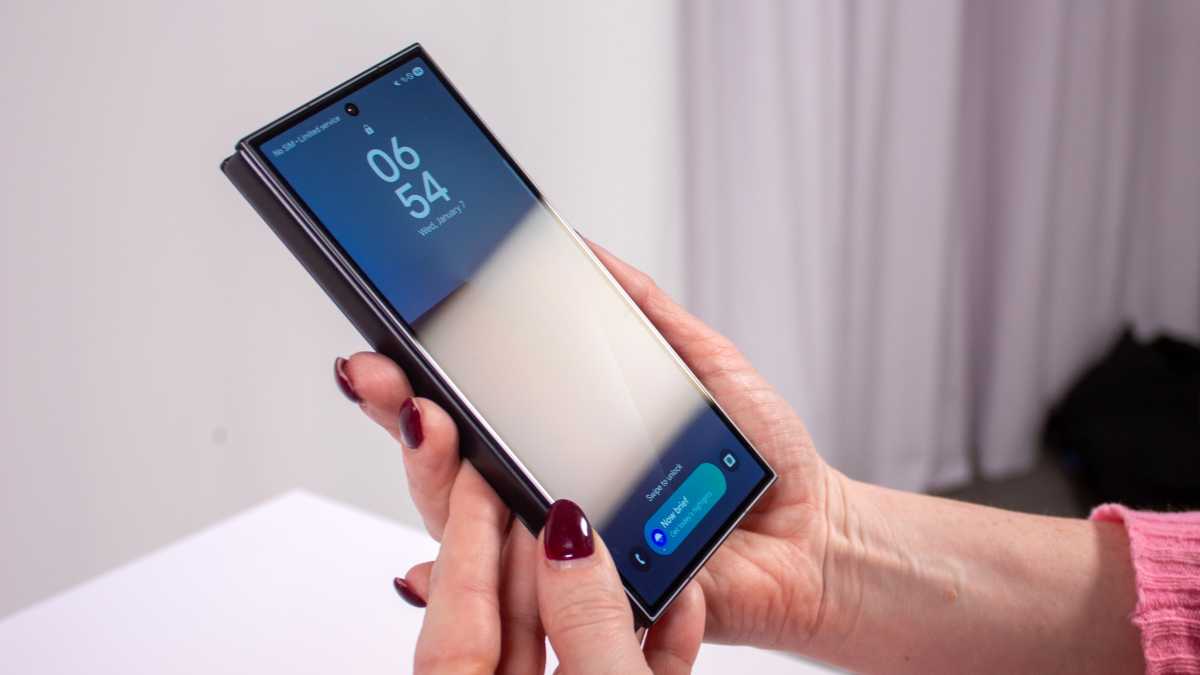
When folded, the Galaxy Z TriFold has a 6.5-inch external display, which has always been one of my favourite sizes. It’s big enough to do whatever you might need, but not so big that you have to stretch your thumb to reach the top when using one-handed.
It’s an AMOLED display with a Full HD+ resolution, and it looks great. Think sharp detail, punchy and vibrant colours and decent contrast. It’s what you would expect from a flagship phone, and while the resolution is lower than many of the best Android phones offer, that didn’t seem to be an issue for anything I pulled up.
Britta O’Boyle
Open up the Galaxy Z TriFold, however, and that’s where it comes into its own. The internal display is 10 inches, which almost puts it into Apple iPad Air and Samsung Galaxy Tab S11 territory, both of which are 11 inches. It too is an AMOLED panel, so the app icons pop with colour, while everything from articles on the browser to videos on YouTube looks great.
There is always the caveat with folding phones that, for the convenience of being able to have a pocketable larger screen, you have to contend with things like the creases in the display where the phone folds. For the Galaxy Z TriFold, there are, of course, two of these on the internal display, but I didn’t find them especially noticeable. You can see them if you really look, but they aren’t off-putting.
Britta O’Boyle
There is no support for Samsung’s S Pen, however, which is a shame given that it would be perfect on such a large internal display. Both displays – and the rest of the body, for that matter – also really love a fingerprint, so you’ll need to be prepared to wipe the Galaxy Z TriFold down a lot.
A small step down in performance
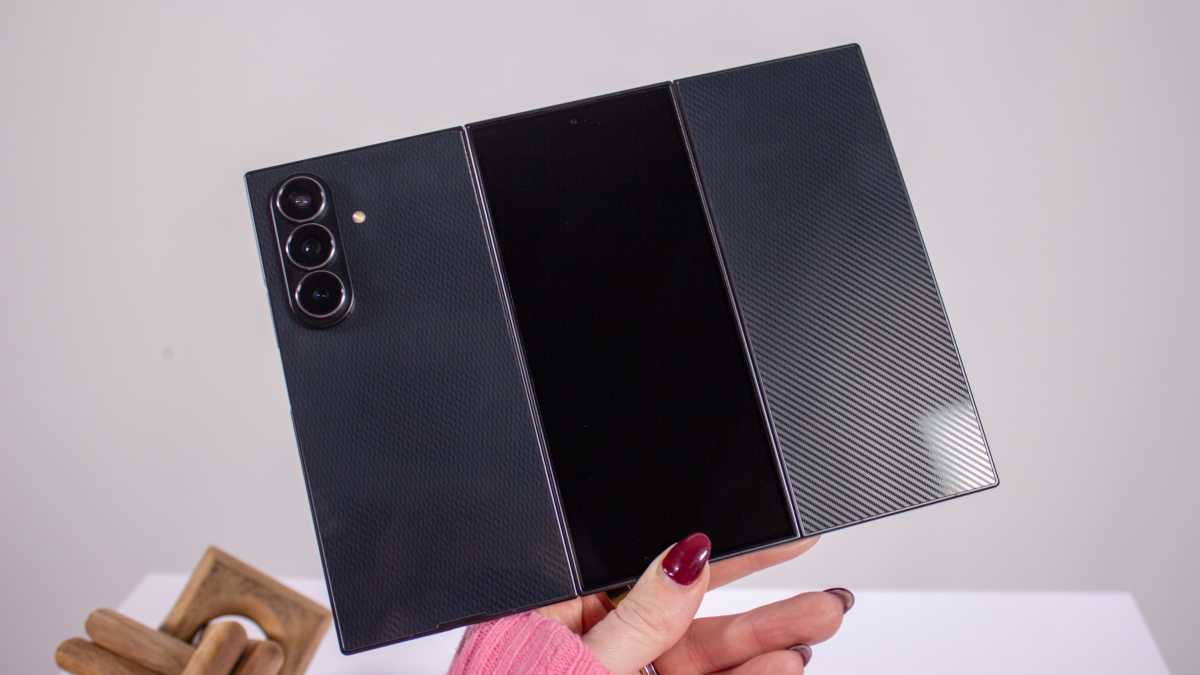
Under the hood of the Samsung Galaxy Z TriFold is the Qualcomm Snapdragon 8 Elite. It’s the same processor you’ll find in the likes of the Galaxy S25 Ultra and many of the best Android phones of last year, but it isn’t the latest. Qualcomm announced the Snapdragon 8 Elite Gen 5 towards the end of 2025, but despite arriving afterwards, the Galaxy Z TriFold opts for the older chip.
Britta O’Boyle
Based on my brief experience, that didn’t seem to matter. Everything runs smoothly without any lag, with apps opening swiftly and the Z TriFold more than capable of switching quickly between tasks.
It’s something to keep in mind, though. The Galaxy Z TriFold won’t be cheap wherever you buy it, so not getting the latest hardware feels like a kick in the teeth.
The main rear camera does match Samsung’s flagship standard phone, however. That’s the same 200Mp main sensor as Galaxy S25 Ultra and the Galaxy Z Fold 7. There is also a 12Mp ultra-wide sensor like the Galaxy Z Fold 7 and a 10Mp telephoto sensor offering 3x optical zoom.

Britta O’Boyle
You’ll also find two 10-megapixel front cameras on the Galaxy Z TriFold, again like the Galaxy Z Fold 7, with one on the front of the external display and the other on the internal display. I couldn’t test their performance during my hands-on, but these are tried and tested from Samsung’s other most recent foldable phones, so I’d expect the same performance.
The Galaxy Z TriFold won’t be cheap wherever you buy it, so not getting the latest hardware feels like a kick in the teeth
The software is very clever
The Galaxy Z TriFold runs on Android with Samsung’s One UI 8 overlaid on top, so it’s a familiar experience to anyone who’s used a recent Galaxy phone. There’s some bloat on top of what you would find on Google’s Pixel phones, but the overall experience is a great one.
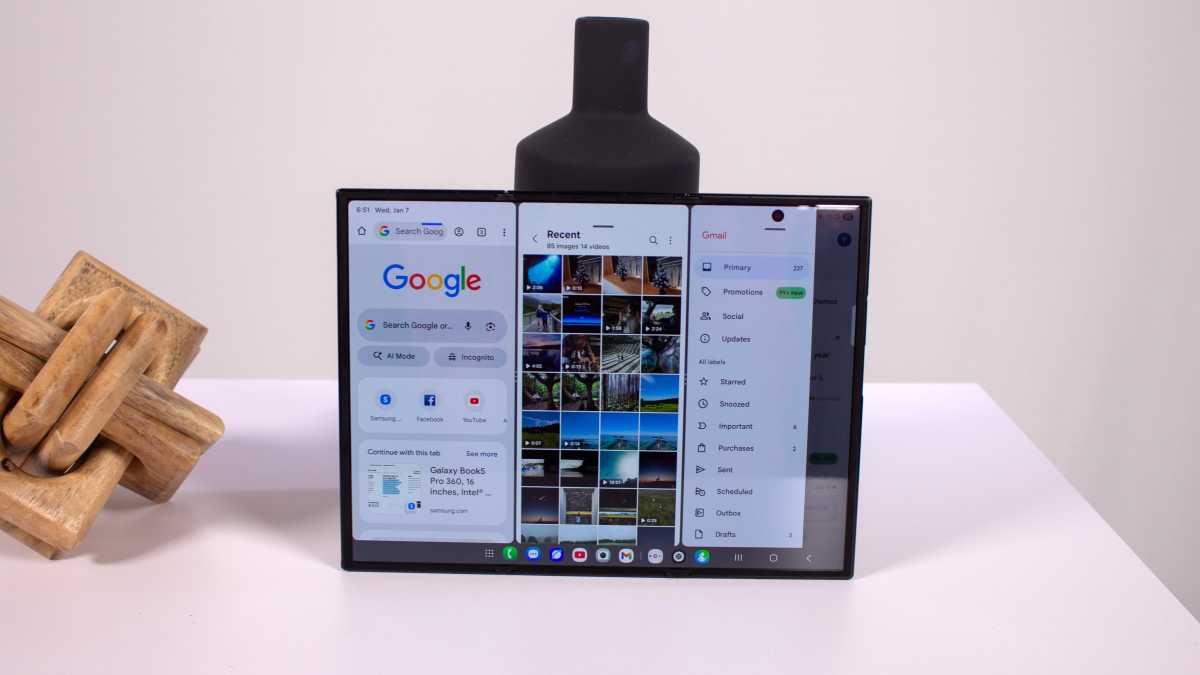
As you might expect, the Galaxy Z TriFold does have a couple of tricks up its sleeve to take advantage of the large internal display. It’s excellent for multi-tasking, with three apps able to run side by side and each being the same size as what you would see on a standard smartphone. You can easily copy and paste between them or edit images side by side.
Britta O’Boyle
If you go to write an email or a message, the on-screen keyboard on the Galaxy Z TriFold will appear on either side of the internal display, depending on what makes most sense. For a more desktop-like experience, there’s also full support for Samsung DeX.
One of the best software features I noticed during my short time with the Galaxy Z TriFold, however, was a warning. When you go to close it the wrong way (and you absolutely will, numerous times), the phone vibrates, and a message appears on the left side to highlight that you need to close the other panel first. It’s a simple yet effective way to ensure you don’t do any damage.
Still one big caveat
The Samsung Galaxy Z TriFold is an impressive phone and one that shows just how far smartphones have come in the last decade. The slim and light design is lovely, both screens look great, and the software is a testament to how much experience Samsung has in the folding phone field.
If you want a smartphone that’s ahead of its time, the Galaxy Z TriFold is for you
However, there are downsides. It attracts fingerprint smudges, lacks S Pen stylus support and offers none of the viewing angle flexibility available on the Galaxy Z Fold 7.
But undoubtedly the biggest problem with the Galaxy Z TriFold is its availability, or lack thereof. At the time of writing, it’s exclusive to Samsung’s native South Korea. A US launch is planned for Q1 of 2026, but there’s no word on UK or European availability.
Hopefully that’ll change at some point soon, though. Because if you want a smartphone that’s ahead of its time, the Galaxy Z TriFold is for you.